
Reviewed by Stephen Aryan
The ancient city of Villjamur is threatened by a long-expected ice age, and thousands of refugees from the coming freeze are camped outside its gates, causing alarm and the threat of disease for the existing population. When the Emperor commits suicide, his elder daughter, Rika, is brought home to inherit the Jamur Empire, but the sinister Chancellor plans to get rid of her and claim the throne for himself. Meanwhile an officer in the Inquisition, in pursuit of a mysterious killer, also uncovers a conspiracy within the Council to solve the refugee crisis by wholesale slaughter, and a cultist magician is causing a trail of havoc in his search for immortality and his obsessive quest to gain access into another world. To the far fringes of the Empire is despatched military commander to investigate a mysterious new race of undead that seems intent on genocide of the most gruesome nature.
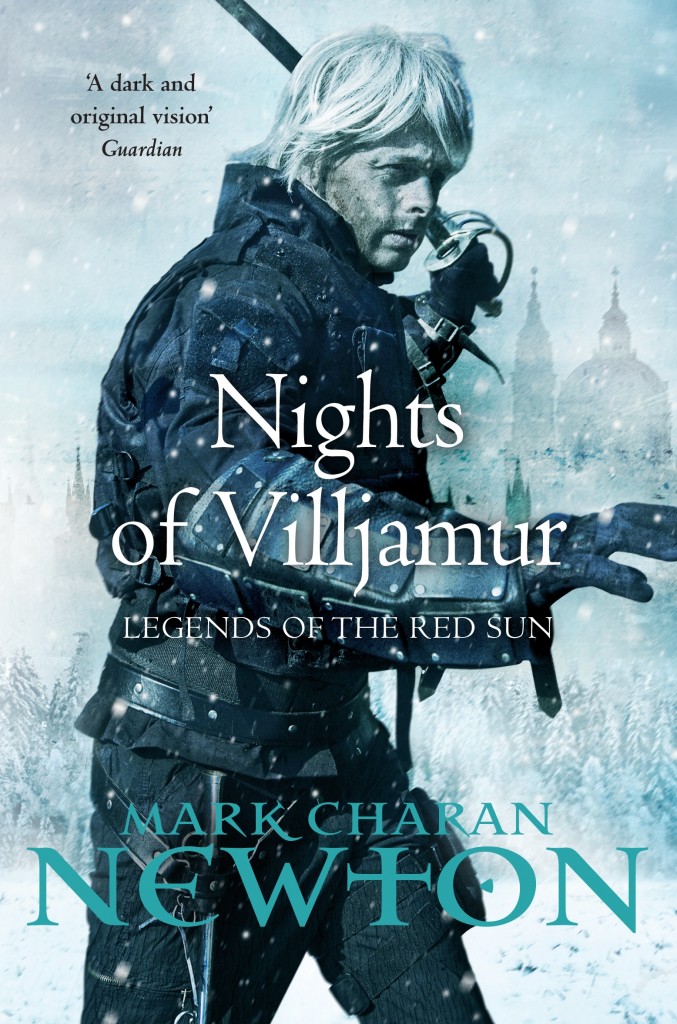 An ice age is set to sweep the world as the sun dies and people everywhere are struggling to cope. Thousands of refugees are camped outside the city of Villjamur, hoping for sanctuary and salvation, and it is into this unstable and politically volatile situation that the story takes place.
The story primarily focuses on three characters, Commander Brynd, loyal soldier of the Empire and confidant of the unstable and paranoid Emperor; Randur Estavu, who at first glance is a foppish dandy and womanizer that only has his own best interests in mind; and Inquisitor Jeryd, a middle-aged investigator who was so focused on his work, he didn’t realise what was important until it was gone. The other main character is the city of Villjamur itself, which is a huge sprawling mass of towers, twisty narrow streets and dangerous dark corners. It is a place of horrific murder, amazing wonder and magic, desperation, poverty, hunger, and majesty. It breathes and is perhaps the best actualised city and setting I’ve read in a fantasy book in a long time. I don’t have to work hard to imagine it because after a while I could see it all, and feel the endless rain and snow showers that blight the population. It is the combination of a lot of different elements, but it feels as if it has all been put together with considerable thought and not just jammed in there because the author thought it would be cool.
I’ve read in a couple of interviews who some of Newton’s influences are and for those familiar with them, you can see it in his style and some of the prose. There are also what I think are little Easter eggs with an albino character making me think of Moorcock, elements of the weird in the city recall Miéville and in a scene involving the undead their was mention of Shelley tanks which was nice. They don’t intrude though, so it’s a nod of respect to progenitors of the fantasy and weird genres.
Newton doesn’t deal in simple. Like the city, his characters are complex and emotionally rich, struggling to cope with the rising tide of fear all around them whilst doing their jobs and just getting on with their lives. We all struggle to maintain a healthy work/ life balance and sometimes it is difficult to focus on your work if there is something happening at home that plays on your mind. This brings a level of realism to the characters that makes it easier to relate to them, despite never being in their particular situations. This balance struggle particularly applies to investigator Jeryd, who is a rumel, a race with an extended lifespan who co-exist with humans and, whilst investigating a political murder, he is distracted by his failing relationship with his wife. Brynd is sent on a few missions to investigate rumours of rebels and uprisings that threaten the Empire, whilst also trying to keep a secret of his own that would undo all of his accomplishments. Randur at first was my least favourite character, but as the story progresses you realise there is a lot more going on beneath the surface and slowly he opens up to another character and we get to see what really makes him tick.
There is a lot going on in this story and as it progressed it quickly became apparent to me that this was the first book in a series. To have attempted to tie everything up quickly would have been a big mistake. While at the end of it I felt as if we had explored a lot of the city of Villjamur itself, we’ve barely scratched the surface of the world, although we do get to visit a few locales. The world building is done well, with hints at previous generations and cultures, and the current populace just built on top of the ruins, without really knowing or understanding what came before. The multicultural situation in the city with human, rumels and garudas, bird-men who are typically scouts in the army, is not really explored and just taken as a given, but to be honest it’s not really needed. My only minor complaint is we don’t really know much about rumels and I can’t see them very clearly. I think there is more going on than we know and it might be explored later in another book, but I would have liked a bit more about their physicality. Also they don’t have a unique culture or any customs of their own, which suggests to me that perhaps they have been part of the norm and integrated with humans for so long they’ve forgotten. It’s a point I’ll try to remember and come back to once I’ve read City of Ruin, the sequel, as I might get my answer there.
My other slight niggle, and it’s a personal thing, is Newton has obviously created something that is very much his own, in his own world with its own style, but on maybe a dozen occasions the dialogue strays into the modern which was jarring and it felt uneven because it was so infrequent. Other authors use modern dialogue throughout including slang, and their worlds become a hybrid, so from the start you become use to that particular style and rhythm. But with Newton, sometimes his characters use the word “Ok”, which seemed an odd choice to me, but most of the time they don’t. I didn’t have any problems with the swearing, which I’ve seen mentioned elsewhere a couple of times, as it was in keeping with the story and setting, but as I said, it’s a personal niggle and others may not even notice.
There are a number of mysteries in the book, and some of the local ones are unravelled, but there is a much bigger story running parallel with several threads and these will continue to be explored in future instalments, but I can’t go into any more detail without spoiling them. So although towards the latter part of the story it does feel like the first in a series, there is an ending to one chapter and some resolution. Several plot threads are left hanging to be picked up later and new ones are emerging that will undoubtedly weave themselves into the big picture.
As I said earlier, this is not a simple book, it deals with a number of important adult themes which are very significant in today’s society, such as politics, poverty, sexuality, survival and relationships. Also, despite it falling into the fantasy genre, it is the combination of several, as Jeryd’s investigation into the murder becomes a noir police procedural at times, and both his, Randur and Brynd’s stories contain elements of horror. There were a couple of moments of dramatic irony, where the reader knew more than the characters and we were waiting for them to catch up, but events then played out as expected which was a surprise as I thought there would be a twist or two. Nevertheless this is not a predictable read and with so many elements on the go, I didn’t know how the story was going to end or what was going to happen. Perhaps it’s also worth mentioning that this is a debut novel and it is a significant accomplishment for a first book by an author that has a unique voice and style. I thoroughly enjoyed it and would highly recommend it if you want a meaty, thought provoking read, where the characters are rich and engaging and the world is a complex and well thought out landscape.